What Is Frame Rate in Gaming? FPS Definition, Examples & Why It Matters
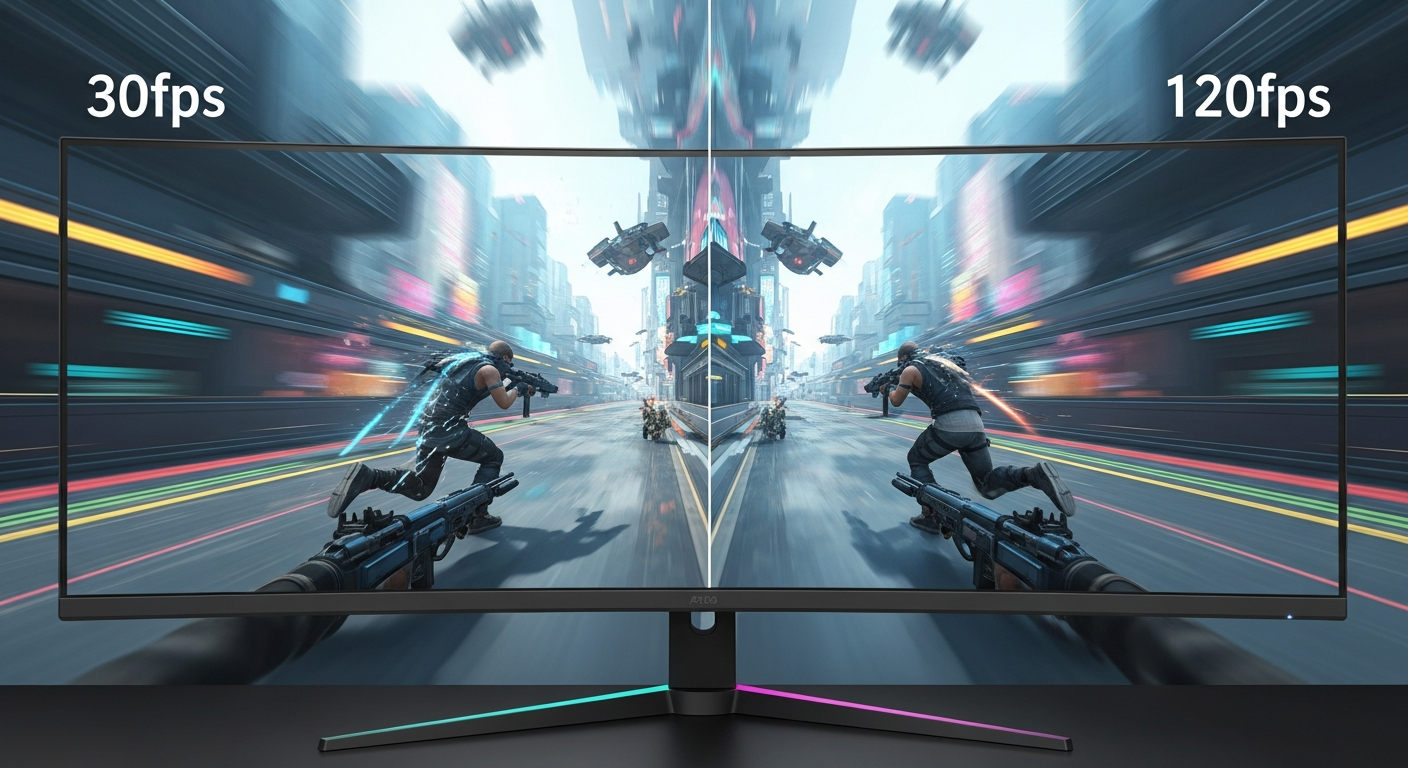
Upgrading from 30fps to 60fps cuts motion blur by 50%, and competitive players say it doubles their reaction accuracy in fast-paced shooters.
This guide covers what frame rate means, how it affects your gameplay, and why it matters more than most gamers realize.
- Frame rate (FPS) measures how many individual images your screen displays each second.
- 30fps is the minimum for playable games; 60fps is the modern standard.
- 120fps and above gives competitive players a real edge in reaction time.
- The gap between 30fps and 60fps is far bigger than the gap between 60fps and 120fps.
What Is Frame Rate?
What is frame rate? Frame rate, measured in frames per second (FPS), is the number of still images your GPU renders and your monitor displays each second. A game running at 60fps shows 60 unique images every second.
Each frame is a complete snapshot of the game world at that moment. Your GPU calculates the position of every object, the lighting, textures, and effects for each frame. The more frames per second, the smoother motion appears on screen.
Frame rate is not the same as animation. Animation refers to pre-made sequences. Frame rate is real-time rendering that responds to your inputs, like moving a character or aiming a weapon.
How Does Frame Rate Work in Games?
Your GPU (graphics processing unit) renders each frame. It calculates geometry, textures, lighting, and post-processing effects. The time it takes to render one frame determines your FPS.
If your GPU renders a frame in 16.67 milliseconds, you get 60fps. If it takes 33.33 milliseconds, you get 30fps. Faster GPUs and simpler scenes produce higher frame rates.
Most monitors have a fixed refresh rate. A 60Hz monitor can only display up to 60fps, even if your GPU renders more. A 144Hz monitor can display up to 144fps, making high frame rates actually visible.
| Frame Rate | Frame Time | Experience Level | Best For |
|---|---|---|---|
| 30fps | 33.33ms | Minimum playable | Casual, story-driven games |
| 60fps | 16.67ms | Smooth standard | Most gaming genres |
| 120fps | 8.33ms | Premium smooth | Competitive shooters, racing |
| 240fps | 4.17ms | Ultra responsive | Esports, pro-level play |
Why Does Frame Rate Matter for Gamers?
Higher frame rates mean smoother visuals and faster response to your inputs. In competitive games, this translates to real advantages.
Input lag reduction. At 30fps, there is a 33ms delay between your action and the screen update. At 120fps, that drops to 8ms. This affects aiming, dodging, and timing in every game.
Visual clarity during motion. Fast camera movements create motion blur at low frame rates. Higher FPS keeps the image sharp, making it easier to track enemies or read text while moving.
Smoother animations. Character movements, particle effects, and UI transitions all look better at higher FPS. This improves the overall feel of a game, even in single-player titles.
Frame Rate vs Refresh Rate: What Is the Difference?
Frame rate and refresh rate are related but different measurements.
Frame rate (FPS) is how many frames your GPU produces per second. This depends on your hardware, game settings, and scene complexity.
Refresh rate (Hz) is how many times your monitor updates the image per second. This is a fixed spec of your display, like 60Hz, 144Hz, or 240Hz.
If your GPU renders 120fps but your monitor is 60Hz, you only see 60fps. The extra frames are wasted. To benefit from high frame rates, you need a monitor with a matching or higher refresh rate.
Technologies like NVIDIA G-Sync and AMD FreeSync sync your GPU’s frame rate with your monitor’s refresh rate. This eliminates screen tearing, where parts of two frames appear on screen at once.
Examples of Frame Rate Impact in Popular Games
Different games benefit from high frame rates in different ways.
Valorant and Counter-Strike 2. These competitive shooters run at 300+ fps on modern hardware. Pro players use 240Hz monitors because every millisecond counts in gunfights.
Cyberpunk 2077. This open-world game with ray tracing often runs at 30-60fps even on high-end PCs. The visual quality trade-off is worth it for many players in a story-focused game.
Elden Ring. The game targets 60fps on consoles. Players using frame rate unlocking mods report smoother combat and better dodge timing.
Fortnite. Competitive players lower graphics settings to maximize FPS. The game’s building mechanics reward fast reactions that high frame rates enable.
How Frame Rate Affects Game Development
Developers must balance visual quality with frame rate performance. A game with stunning graphics that runs at 20fps will frustrate players.
Target frame rate decisions. Console games often target 30fps with high graphics or 60fps with reduced visuals. Some games offer both modes, letting players choose.
Optimization work. Developers spend months optimizing code, reducing draw calls, and implementing techniques like level-of-detail (LOD) to maintain stable frame rates.
Platform-specific tuning. A game on Nintendo Switch may target 30fps, while the same game on PS5 targets 60fps. Each platform requires different optimization strategies.
Building a High-Performance Game?
Our team optimizes frame rates across PlayStation, Xbox, Switch, and PC. Talk to our engineers about your next project.
Limitations
Frame rate is not everything. Here are some important caveats.
Diminishing returns. The jump from 30fps to 60fps is dramatic. The jump from 60fps to 120fps is noticeable but smaller. Beyond 144fps, most players cannot tell the difference.
Hardware costs. Running modern games at 120fps or higher requires expensive GPUs and monitors. The cost-to-benefit ratio drops sharply above 60fps for casual gamers.
Frame pacing matters too. A game averaging 60fps with frequent stutters feels worse than a stable 50fps. Frame time consistency is as important as the FPS number.
Not all games need high FPS. Turn-based strategy games, visual novels, and point-and-click adventures play perfectly at 30fps. Frame rate matters most in fast-action genres.
Frequently Asked Questions
Q1: What is a good frame rate for gaming
60fps is the standard for smooth gameplay in most genres. Competitive players aim for 120fps or higher. Anything below 30fps feels choppy and unresponsive.
Q2: Can the human eye see above 60fps
Yes. Studies show humans can perceive differences up to 200fps or more. The difference between 60fps and 144fps is clearly visible in fast-moving content.
Q3: Does higher FPS make you a better gamer
Higher FPS reduces input lag and improves visual clarity. This gives you a real advantage in competitive games, but skill and practice matter more.
Q4: Why does my game drop FPS in busy scenes
More objects on screen means more work for your GPU. Explosions, crowds, and detailed environments all increase render time per frame. Lowering graphics settings helps.
Q5: Is 30fps acceptable for gaming
30fps is playable for slow-paced, story-driven games. It feels sluggish in fast action games. Most players prefer 60fps as the minimum for a good experience.