What Is Ray Tracing in Gaming? Definition, Examples & Why It Matters
NVIDIA’s RTX cards can cast billions of light rays per second, yet real-time ray tracing was considered impossible in gaming just a decade ago. Today, it powers the most visually stunning games on PC, PlayStation 5, and Xbox Series X.
This guide covers what ray tracing is, how it works at a technical level, and why it changes the way games look and feel.
- Ray tracing simulates realistic lighting by tracing individual light rays as they bounce through a 3D scene.
- NVIDIA RTX and AMD RDNA 4 GPUs support real-time ray tracing with AI upscaling (DLSS, FSR) for playable frame rates.
- Over 200 games support ray tracing as of 2026, including Cyberpunk 2077, Minecraft, and Alan Wake 2.
- Ray tracing replaces fake lighting tricks with physically accurate reflections, shadows, and global illumination.
What Is Ray Tracing?
What is ray tracing? Ray tracing is a rendering technique that simulates how light behaves in the real world. It traces the path of light rays as they travel from a light source, bounce off surfaces, and reach the camera.
Traditional game rendering uses a method called rasterization. Developers place fake lights and manually paint reflections and shadows. Ray tracing replaces these tricks with real physics calculations.
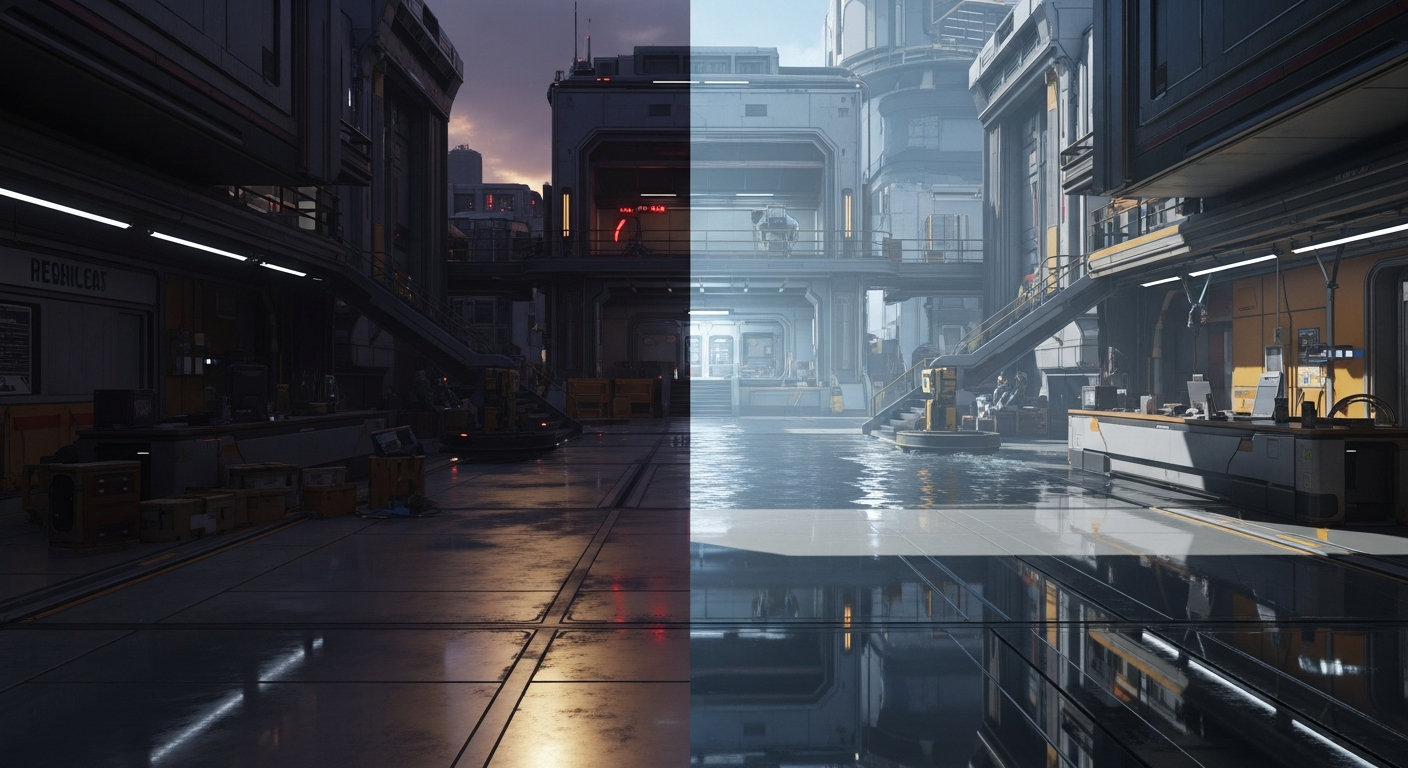
The result is more accurate reflections on water and glass, soft shadows that change with light direction, and global illumination that fills rooms with natural bounced light. These effects make game worlds look closer to what we see in movies.
How Does Ray Tracing Work in Games?
Ray tracing works by casting rays from the camera through each pixel on screen. When a ray hits a surface, the system calculates what color that pixel should be based on the material, light sources, and nearby objects.
Each ray can bounce multiple times. A ray hitting a mirror reflects and continues. A ray hitting glass refracts and bends. A ray hitting a wall scatters in many directions, creating soft indirect lighting.
This process needs massive computing power. A single frame at 1080p can require millions of rays. Modern GPUs like the NVIDIA RTX 5070 use dedicated ray tracing cores to handle this workload in real time.
| Game | Ray Tracing Features | GPU Recommendation |
|---|---|---|
| Cyberpunk 2077 | Full path tracing, reflections, GI | RTX 4070 or higher |
| Alan Wake 2 | RT reflections, RT transparent reflections | RTX 4060 or higher |
| Minecraft (Bedrock) | RT global illumination, RT shadows | RTX 3060 or higher |
| Portal with RTX | Full path tracing | RTX 4070 or higher |
| Spider-Man 2 | RT reflections, RT ambient occlusion | RTX 4060 or higher |
Why Does Ray Tracing Matter for Gamers?
Ray tracing changes how games feel, not just how they look. Realistic lighting creates a sense of presence that static lighting cannot match.
Reflections are the most visible improvement. In games like Cyberpunk 2077, puddles and windows reflect the entire scene around them. Characters appear in mirrors. Neon signs glow on wet streets.
Shadows also improve dramatically. Ray-traced shadows have soft edges that change based on light distance and size. Trees cast dappled shadows that move naturally. Indoor scenes have shadows that match the shape of windows and objects.
Global illumination is the most complex effect. It simulates light bouncing between surfaces, filling dark corners with color from nearby objects. A red wall next to a white floor will cast a subtle red glow on the ground. This level of detail was impossible with older rendering methods.
Ray Tracing vs Rasterization: What Is the Difference?
Rasterization is the traditional method for rendering 3D graphics in games. It converts 3D objects into 2D pixels on screen using geometry and math shortcuts.
Rasterization draws triangles on screen and calculates lighting per pixel using pre-baked data. Developers place light probes, reflection cubemaps, and shadow maps manually. The results can look good, but they are approximations.
Ray tracing simulates actual light behavior. No manual setup is needed for reflections or shadows. The physics engine handles it automatically. The trade-off is performance: ray tracing needs much more GPU power.
Most modern games use a hybrid approach. They rasterize the base image and add ray-traced effects on top. This gives good performance while still improving visual quality where it matters most.
Examples of Ray Tracing in Popular Games
Ray tracing adoption has grown fast since NVIDIA launched the first RTX cards in 2018. Here are some standout implementations.
Cyberpunk 2077 has the most advanced ray tracing mode in any game. Its “Overdrive” mode uses full path tracing, replacing all traditional lighting with ray tracing. The result looks like a movie, but needs an RTX 4090 to run smoothly.
Minecraft with RTX transforms the blocky world with realistic water reflections, soft shadows, and glowing lava that lights up caves naturally. It shows that ray tracing improves any art style, not just realistic games.
Alan Wake 2 uses ray tracing for reflections on dark lakes, glass windows in the forest, and the flashlight’s interaction with fog. The atmosphere is significantly more immersive with RT enabled.
Portal with RTX is a free update that adds full path tracing to the classic puzzle game. It demonstrates how ray tracing can modernize older games with physically accurate lighting.
How Ray Tracing Affects Game Development
Ray tracing simplifies some aspects of game development while adding new challenges.
Developers no longer need to manually place reflection probes or bake lightmaps. Ray tracing handles these automatically, saving hours of level design work. This is especially useful for dynamic environments where lighting changes during gameplay.
The challenge is optimization. Not all players have ray tracing capable hardware. Developers must build two rendering paths: one with ray tracing and one without. Testing and balancing both paths adds development time.
Game engines like Unreal Engine 5 and Unity have added ray tracing support, making it easier for developers to implement. Unreal Engine 5’s Lumen system combines software and hardware ray tracing for a scalable solution.
Building a Game with Ray Tracing?
Our team implements advanced rendering across PlayStation, Xbox, and PC. Talk to our engineers about your next project.
Limitations
Ray tracing has real drawbacks that every gamer should understand.
Performance cost. Enabling ray tracing can cut frame rates by 30-50%. Players with older or budget GPUs may not get playable performance. AI upscaling tools like DLSS and FSR help, but they add their own visual artifacts.
Hardware requirements. Real-time ray tracing needs a GPU with dedicated RT cores. This means NVIDIA RTX 20-series or newer, or AMD RX 6000-series or newer. Older cards cannot run ray tracing at acceptable speeds.
Visual differences are subtle. In fast-paced games like shooters, players rarely notice ray-traced reflections during combat. The visual upgrade is most visible in slow, atmospheric games with lots of reflective surfaces.
Game support varies. Not all games implement ray tracing equally. Some only add RT reflections or shadows, while others use full path tracing. The quality of implementation depends on the developer’s skill and budget.
Frequently Asked Questions
Q1: Is ray tracing worth it
Ray tracing is worth it if you have a mid-range or better GPU (RTX 4060 or RX 7600) and play atmospheric games. For competitive shooters, the frame rate hit often outweighs the visual benefit.
Q2: What GPU do I need for ray tracing
You need an NVIDIA RTX 20-series or AMD RX 6000-series GPU at minimum. For good performance at 1440p, an RTX 4070 or RX 7800 XT is recommended. Budget cards like the RTX 4060 handle 1080p ray tracing well.
Q3: Does ray tracing work on consoles
Yes. PlayStation 5 and Xbox Series X both support hardware ray tracing. Console games typically use limited RT effects like reflections or shadows at 30-60 fps, not full path tracing.
Q4: What is the difference between ray tracing and path tracing
Path tracing is a form of ray tracing that traces rays multiple times as they bounce around a scene. It produces the most realistic results but is the most demanding. Ray tracing is the broader term for any light ray simulation.
Q5: Can AMD cards do ray tracing
Yes. AMD RX 6000 and newer cards support hardware ray tracing. Performance is generally lower than NVIDIA equivalents, but AMD’s FSR upscaling helps maintain playable frame rates.